Tuesday, 26 July 2016

An interview with...

…today I have the great pleasure of interviewing author Shani Struthers.  Hello and welcome, Shani, and I know your time is precious so…

AW  ...tell me, what is your current release?
Shani''s latest book
SS  My latest release is 'Psychic Surveys Book Three: 44 Gilmore Street'.  As you can see from the title it’s the third in what will be a series of six.  There’s also a spin-off prequel novella featuring two sub-characters from the book called 'Eve: A Christmas Ghost Story'.  In short, the books centre round Ruby Davis and her high-street business – Psychic Surveys – a team of gifted psychics who specialise in domestic spiritual clearance.  Called in to help on a variety of cases, it’s a series that delves into the supernatural and how it impacts on us in the natural world – sometimes the divide between the two is thin and that’s when the problems start!

AW  What first got you into writing and why?
SS  Reading and writing have always been twin passions, ever since I could do both!  When I left university, I worked in travel for a couple of years and then left to become a freelance copywriter.  I always wanted to write novels but I was busy with work and then three children came along and I kept putting it off.  About three years ago I finally got my act together, wrote my first book and now I can’t stop – I try, honestly, it’s good to have a bit of a break – but I just can’t.  I love writing; it makes me happy, if others enjoy what I write then, wow, what a bonus.  Flitting between the real world and a world I’ve created does get quite surreal at times!

AW  You write Paranormal novels.  Is it all imagination or do you also undertake research?
SS  I research all the time – reading non-fiction books on the subject as well as fiction books, to see how others have interpreted certain topics.  I also love to mix fact with fiction – and I draw on and mention the work of famous Occultists such as Aleister Crowley and Dion Fortune.  I’m launching a new series this summer – a set of stand-alone novels set in and around the world’s most haunted places.  The first – This Haunted World Book One: The Venetian – is set on Poveglia in the Venetian lagoon, considered to be ‘the world’s most haunted island’ and weaves a story around what is essentially fact.  Google Poveglia to find out more!

AW  And what about other types of writing? Have you ever dabbled with short stories, for instance, or other genres?
SS  I first kicked-off writing romance – the Runaway trilogy set in North Cornwall.  I love those books and they taught me a lot about writing but the paranormal is where my heart lies – and it always has done.  I’m very comfortable with what I’m doing now and will stick to it for the foreseeable future.  As for short stories, I’ve never written one!

AW  Famous authors, such as Roald Dahl and Dylan Thomas, had a special place for writing.  Do you have a ‘writing shed’ of your own?
The Psychic Surveys series
SS  In our house my husband (an ex-musician) has his music room and I’ve got my writing room.  My desk is placed overlooking the garden and I’ve got bookcases all around me, where my books reside alongside the likes of Stephen King and Dean Koontz!  I don’t write anywhere else but there.

AW  Finally, if you had a whole afternoon to yourself and could choose to spend it with anyone, living or dead, or a character from a book – who would it be and what would you want to discuss?
SS  Ooh, what a toughie!  There’d be so many but… if I have to choose one, I’d say Elvis.  I’d want to know all about the early days, his hunger, his passion, his drive and then I’d want him to tell me where it all went wrong and why.  I love Elvis, no other artist moves me as much as he does.

About the Author... Born and bred in the sunny seaside town of Brighton, one of the first literary conundrums Shani ahd to deal with was her own name - pronounced Shay-nee not Shar-ney or Shanni!  Hobbies include reading, writing, eating and drinking - all four of which kept her busy enough. After graduating from Sussex University with a degree in English and American Literature, Shani became a freelance copywriter.  Twenty years later, the day job includes crafting novels too.

Facebook Author Page: http://tinyurl.com/p9yggq9
Website: http://www.shanistruthers.com

Tuesday, 19 July 2016

Following Stevenson through the Cévennes

Surrounding countryside, La Garde
I’m leaving Robbie’s book, ‘Travels with a Donkey’, behind today as I take you on another trip through the Cévennes.  It’s not that I’m finished with Mr Stevenson, I will re-read his book at some point in the future, it’s just that, today I’m taking you somewhere I want to go, La Garde-Guérin.  A place that my erstwhile friend missed because the route he chose ran across Mont Goulet to the west of La Garde.

From Langogne if you take the D906 south to Luc, La Bastide and Prévenchères, the road gradually rises until you reach the village, which sits at an altitude of around 900m above sea level on a sparse and dusty plateau.  With little more than a dozen inhabitants this tiny village is isolated but it is also blissfully quiet – apart from the tourists who flock here in July and August.

A village street
The village is crossed by the Chemin de Régordane (GR700), which was once an important and the only communication route between Languedoc and the Auvergne.  It was the Bishop of Mende who requested that a guard post be instituted at this point on the route as far back as the 12th century.  He wanted to protect pilgrims and of course, goods being transported, so he insisted that the village also becomes a garrison and a group of knights moved in.  Not quite the sort in shining armour, I’m afraid, as these men were there to escort travellers and carts in safety and were able to charge for the privilege.

The watch tower
The tower that currently stands at one side of the village with its commanding view over the wild countryside is not the original one.  The village was the scene of fierce fighting and was raised to the ground during the Hundred Years War and was again burned in the 16th century during the Religious Wars.  The tower stands at just over 21 metres high and can be seen for miles around.  It is possible to climb to the top using ladders mostly and in one section, footholds and handholds in the walls.  I wasn’t wearing my four-wheel drive for feet on the day I visited, so I decided to leave all the climbing to others.

The village church is equally tiny and is dedicated to St Michael and contains a statue of the patron saint dating from the 15th century.  Inside the church is cool and dark and silent and the decorative masonry is certainly worth a detailed examination.

And so I make my way further along the D906 towards Villefort, the lake and lunch.

There's more from RLS and me here

Tuesday, 12 July 2016

An interview with...

Meet Dagda...
Dagda  Greetings Scribe Angela.
AW  Well, hello Dagda and thank you for agreeing to appear on my blog this week.  Would you like to tell us a little about yourself?
D    I am Dagda from Scribe Ailsa's books ‘Alchemy’ and ‘Shaman's Drum’.  You meet me first as a young Captain in the Black Shaman's Guild who is given Riga, the female lead, to train.  By the second book, I am head of the Guild.

AW  Wow!  That’s some achievement.  But tell me Dagda, have you always lived in one place?
D     I understand that the theme of your blog this month has been travel and living abroad.  Yes, I know a great deal about that.  In my nearly forty years on this good earth I have changed countries and continents.  I have had the pleasure of meeting and living with people from other cultures, which was enriching sometimes and irritating at others.

AW  So where are you from originally?
D     I was born to the Oneida people, part of the Iroquois tribes on the edge of Lake Ottawa facing Canada.  We are a woodland tribe, not much given to horse riding apart from for pleasure or ceremony, something I would find tiresome in my travels.

AW  How interesting!  And what can you tell us about Ailsa’s…sorry, I mean Scribe Ailsa’s plans for you?
D     You will find in a forthcoming book from Scribe Ailsa, my history, once Riga, my Blood-Daughter, is moved from me.  I will not tell too much of that, my new travels, as she has asked me not to spoil it for you.  I will reveal that I take to the road again, including flying which, I loathe.  My tribal name is Death Eagle, which means ‘owl’, and if I were meant to fly I would have been able to take that form.  Being a magic-user I am unable to use modern technology such as computers, telephones or other electrical gadgetry.  Usually these blow up if I touch them so I rely on Once-Born friends to do this for me.  You will imagine my trepidation being up in the air, reliant on a Once-Born in another element, one in which I was not meant to be.  Water, Earth and Fire are my kin but Air is not my home.  You will read why I have to undertake this task when the book is released.
AW  I see.  Go on…
D     In my youth, son of the Faith Keeper (no, not medicine-man) I was being trained to take over but life took a turn.  Perhaps Spirit was guiding me onto the path I was supposed to follow but my heart was broken and my people disowned me in one moon.  I left the Res (reservation) and travelled south to find a cousin who had married out into the Navajo people with a girl who had been on a scholarship exchange in the Res school.  They took me in and helped me recover.  My cousin was a Navajo Ranger, and welcomed my powers and knowledge for assistance in ‘paranormal’ incidents.  The Navajo are a gentle and friendly people who accepted me as their own until I came of age and knew that I had to find my own path which, Spirit would reveal to me.
Achemy - the prequel to Shaman's Drum
I heard of the Black Shaman's Guild in England and a light flicked on in my head.  Here were a group of wands for hire, all dedicated to retribution and using the kind of magic to which I had been led in my younger life.  I packed a small bag and my cousin's family paid my airfare to London.
Being a Native American in London in the mid 1990s, aged sixteen, was a very strange experience.  Older people 's expectations were based on Western movies and I became tired of answering ‘Where's yer horse then, Chief?’ which was not meant unkindly but wasn't very original.
Younger people had a better grounding in what modern Native Americans are like, many of us having become quite famous film stars and singers.  Unfortunately they adopted a weird way of speaking to me that they felt was ‘spiritual’ and New Age.  I was pleased to be accepted into the enclosed order of the Black Shamans.

AW  Fascinating.  But what about Riga?
D     My protégé, Riga, was given to me to train as a final test aged seven.  She was from Latvia, of traditional Shamanic stock but wild and uncontrollable.  If I could teach her I would secure my place in the Guild forever...or so I thought at the time.  I learned her Latvian traditions too.
AW  So what’s next for you?
D     My next journey will be to a new land – my home but thirty years on.  How will it have changed?  How will people feel about me?  Will I still be an outcast?  Why have I been called back?

AW  Yes…
D      Find out later.

AW  I can’t wait!  It has been amazing to meet you Dagda and thank you for coming.
D     Thank you Scribe Angela for inviting me and accept this gift of spicy fruitcake from Scribe Ailsa who sends her regards.  Spirit guide and shield you.
AW  Spicy fruitcake…scrummy!  Thank you and please pass on my best wishes to Scribe Ailsa

About the author...  Ailsa Abraham writes under two names and is the author of six novels.  Alchemy is the prequel to Shaman's Drum, published by Crooked Cat in January 2014.  Both are best sellers in their genres on Amazon.  She has also written gay male romance under her brother's name, Cameron Lawton.
She has lived in France since 1990, enjoys knitting/crochet and until recently was the oldest Hell's Angel in town.  Her interests include campaigning for animal rights, experimenting with different genres of writing and trips back to the UK to visit friends and family.  She runs an orphanage for homeless teddy bears and contributes a lot of work to Knit for Africa.  She is also addicted to dressing up, saying that she is old enough to know better but too wise to care. 

You can follow Ailsa using the links below :
Linked-In

Tuesday, 5 July 2016

Following Stevenson through the Cévennes

The old bridge, Langogne
I’m in Langogne for today’s journey with Robert Louis Stevenson.  In his journal ‘Travels with a Donkey’ RLS states he arrived here in the evening of ‘Monday, September 23rd’ in 1878.  As this was only the second day of his journey he says very little about the town – which is a great shame, because there’s a lot to see here.  But then, on that first day of travel and the preceding few days of preparation, Robbie had had significant trouble with Modestine, fixing his pack on the donkey’s back and generally understanding the relationship between driver and donkey.  Naturally, despite the switch the landlord had given RLS that morning, Modestine knew she was in charge, didn't she!
His journey that day, from Le-Bouchet-St-Nicolas, had not been pleasant.  The temperature was ‘perishing cold’ and he describes the morning as ‘a grey, windy, wintry’ day.  The trek was solitary and the most memorable incident was his sighting of a foal racing through the ‘tanned and sallow autumn landscape.’  A perfect description for the look of the land at that time of year.  As RLS moved across the heights of Velay he looked forward to the ‘wild… mountainous, uncultivated’ land of the Gévaudan.  So, not strictly part of the Cévennes.
Langogne sits astride the Allier, at this point a much narrower river than it’s more mature and wider self at Moulins.  Stevenson descended, probably on a drover’s track, from Pradelles and walked in across the then only bridge spanning the river.  Situated at the meeting of three départements – Lozère, Ardèche and the Haute-Loire - the principle occupation is cattle breeding and rearing (l’élevage).  But the place is also an excellent example of medieval urbanisation.   The modern town surrounds the older, so I just pass through that and go into its heart.
The church dedicated to Sts Gervais and Protais
The original settlement, dating from the 10th century, was built around a Benedictine monastery that was established by Etienne, the vicomte du Gévaudan, and part of those fortifications still exist.  The current church, dedicated to Sts Gervais and Protais and built in the roman style, dates from the 16th century following the sacking of the town in 1568 by the Protestants under the leadership of Mathieu Merle.
Naturally, the building was added to and changed over the years, but the exterior is constructed of a mixture of sandstone and volcanic rock.  The façade dates from the end of the 16th/beginning of the 17th centuries and if you visit, be sure to look at the arch above the main door and read the inscription.  Internally, the pillars in the nave and vaulted ceiling are of particular note, as is the treasury.
I emerge into the sunshine again and the old medieval streets that encircle the church, their houses supporting each other and rising to three and four stories.  I espy ancient doorways that are far too short for 21st century man to negotiate and the remains of one of the gates leading from the old city
to the then, wild and dangerous outside world and much later, the 18th century grain hall.
The Grain Hall and War Memorial
The next day Stevenson left this fascinating little town behind without recording another word in his journal.  I think that was quite dismissive of him because there is so much history to enjoy here.  So, it would appear that Robbie and I are disagreeing again.  But, as I walk across the old stone bridge and then along the path by the edge of the river back to the car park, I know that I can honestly and truthfully say that I have stood where Stevenson stood.  And I kind of think that’s awesome!


There's more from RLS and me here

Tuesday, 28 June 2016

An interview with...

...fellow Crooked Cat author, Tim Taylor.  Morning Tim

TT  Hello Angela, many thanks for inviting me along today.
AW  You're very welcome Tim and I know your time is precious,so tell me, what is your current release?
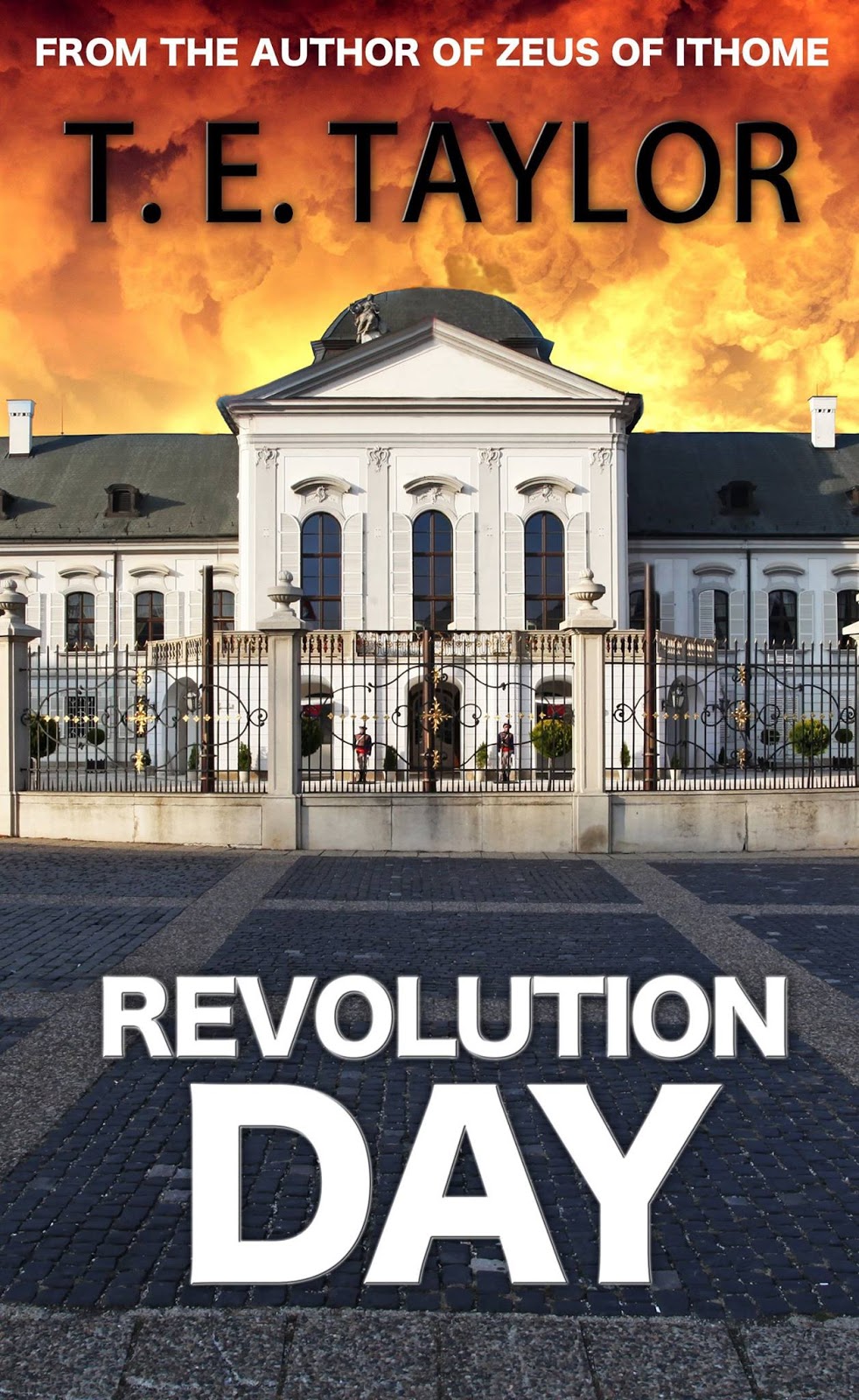
TT  My most recent novel, Revolution Day, follows a year in the life of ageing Latin American dictator, Carlos Almanzor, who is feeling increasingly insecure and paranoid as he clings on to power.  His estranged and imprisoned wife, Juanita, is writing a memoir in which she recalls the history of their marriage and Carlos’s regime, charting its long descent from idealism into repression. 
Meanwhile, the vice-President, Manuel, is burning with frustration at his subordinate role.  When his attempts to increase his profile are met with humiliating rejection, he resolves to take action.  But lacking a military power base, he must pursue power not by force but through intrigue, exploiting his role as Minister of Information to manipulate the perceptions of Carlos and those around him and drive a wedge between the President and the Army.  As Manuel makes his move, Juanita and others close to Carlos find themselves unwittingly drawn into his plans.
For the last week in June and the first two weeks in July (only), Revolution Day is on special offer at 99p/99c.  Further information on the novel, including excerpts and reviews, is available on its page on my website.

AW   What first got you into writing and why?
TT  I’ve always had a creative urge, and I’ve enjoyed writing ever since I was at primary school.  It’s always been a part of my life at some level.  That said, there have been periods when I have found it difficult to make time to do much serious writing, and others when that creative urge found different outlets.  But in the last few years I’ve been able to give much more time to writing, and I’m very happy about that.

AW  You write historical and contemporary novels.  Is it all imagination or do you also undertake research?
TT  It depends.  My first novel, Zeus of Ithome, was set in ancient Greece and followed real historical events – the struggle of the Messenian people to free themselves from centuries of slavery under their Spartan neighbours, and the wider political and military wrangling between rival Greek states.  I already had a good background knowledge of the Greek world, having studied it at university, but I had to do quite a bit of research into the events I was writing about and certain historical characters who appear in the novel, as well as into the way people lived, dressed, ate and fought.  I read the ancient sources and some modern history books, and made heavy use of Wikipedia and Google Earth (for places and landscape).
Revolution Day, on the other hand, was about fictional events set in a fictional country, so it required a lot less research.  I still did some, though – e.g. into hispanic names.  I also looked at a number of historical dictators, though my character, Carlos, is not based upon anyone in particular. 
The novel I am currently writing falls somewhere between the two. It is about a woman’s relationship with her father, as he starts to lose his memory and live increasingly in the past.  I’ve done a fair bit of reading on dementia, and may need to do some historical research about the Second World War period. 

AW  And what about other types of writing?  Have you ever dabbled with short stories, for instance, or other genres?
TT  I write poetry and the occasional short story.  I’ve recently been experimenting with spoken word accompanied by music (at open mic events and the like).  I also write academic non-fiction – my background is in philosophy.  Most of my recent research has been on well-being: what it is, how to measure it and its role in public policy.   

AW  Famous authors, such as Roald Dahl and Dylan Thomas, had a special space for writing. Do you have a writing ‘shed’ of your own?
TT  Not really. I used to do all my writing in a small room we call ‘the office’, which houses a PC, bookshelves, filing cabinets and the like.  I do still work there (I’m in the office right now), but the trouble is that the PC is such a source of distractions, mostly from the internet, that I don’t work very efficiently on it.  For my current work in progress I’ve taken the decision to write downstairs in the living room.  I do have a music room (another interest of mine), and ultimately I’d like it to become the writing room as well, but at the moment it’s too cluttered up with guitars and other musical paraphernalia. 

AW  Finally, if you had a whole afternoon to yourself and could choose to spend it with anyone, living or dead or a character from a book.  Who would it be, and what would you want to discuss?
TT  I’d like to take a person from ancient Greece or Rome, possibly someone like Aristotle or Cicero, and show them as much as possible of the modern world, just to see what they thought of it.

AW  What an interesting idea Tim.  But I’m afraid there’s no room for either or, I’m going to have to press you – Aristotle or Cicero?
TT  It would be great to have them both as it would be interesting to see what they had to say to each other.  But if I'm restricted to just one, as a philosopher, I have to choose Aristotle.  Thanks again for your hospitality, Angela!
AW  You're welcome!

About the author Tim was born in 1960 in Stoke-on-Trent.  He studied Classics at Pembroke College, Oxford (and later Philosophy at Birkbeck, University of London).  After a couple of years playing in a rock band, he joined the Civil Service, eventually leaving in 2011 to spend more time writing.
Tim now lives in Yorkshire with his wife, Rosa, and divides his time between creative writing, academic research and part-time teaching and other work for Leeds and Huddersfield Universities.
Tim’s first novel, Zeus of Ithome, a historical novel about the struggle of the ancient Messenians to free themselves from Sparta, was published by Crooked Cat in November 2013; his second, Revolution Day in June 2015. Tim also writes poetry and the occasional short story, plays guitar, and likes to walk up hills.
Revolution Day on Amazon UK, Amazon US

Tuesday, 21 June 2016

Following Stevenson through the Cévennes

A mountain village
In 1878, when Robert Louis Stevenson decided he would travel through the Cévennes, I'm not absolutely sure that he had considered the seasons, the weather or the look of the countryside.  In his book 'Travels with a Donkey' he mentions to his friend, Sir Sidney Colvin (1845-1927), curator, literary and art critic, that 'we are all travellers' through the 'wilderness of this world'.  Later, in writing about his visit to Luc and Cheylard he says that he travels 'not to go anywhere, but to go.'  He admits he 'travels for travel's sake' and to 'feel the needs and hitches of our life more nearly.'  So I am left wondering, as I have on every other occasion when I've read his book, why he chose to visit this part of France in September and October, as June, in my view, is one of the best times to be here.

As I cross the Col de la Pierre Plantée I marvel at the myriad shades of green around me.  From the pale green of the grass to the dense, inky, champagne-bottle green of the pines.  And in amongst this verdancy are the sunshine yellow clumps of the mimosa that jewel the landscape along with the grey of the vast boulders that seem to be growing out of the ground.  I'm reliably informed that these vast boulders have a specific name - glacial erratics.  Apparently, millions of years ago when this vast untamed area was being formed, the shifting ice sheets brought with them enormous lumps of rock and, as the ice melted and receded, the rocks remained.  I glance at the map and think, technical name or not, I'm with the French on this one.  If they can have a col named after planted rocks, then so can I!

The colours of the Cévennes

Stevenson was not very complimentary about the tiny village of Luc - my destination for today's blog and I have to disagree with him.  The village sits in the valley of the Allier with an old chateau above on the strategic high point.  The path to reach the ruins is rough and begins at the top of the village.  As I am about to begin the climb I meet a modern 'Stevenson' coming down.  I ask him if his donkey is called 'Modestine'.  He hesitates for a moment, then shakes his head and says 'Mouka'.  And then he is gone.  I would have liked the opportunity to talk further, but it is clear he is a man on a mission and I gain the impression that French is perhaps not his first language.

From the chateau ruins it is possible to begin to understand the wildness of this place and how solitary any existence here is.  I can hear cowbells in the distance as the Aubracs sit in the sunshine, graze and then sit again.  Madame at my campsite told me the other day that the last snowfall this year was on May 1st.  Autumn is cold and often brings the icy winds that herald snow and when the snow arrives so do the cross-country skiers.  And just to give some perspective, the chateau at Luc is about 1000m above sea level.  The Col de la Pierre Plantée is 1263m above sea level and my campsite is more or less the same.  Ben Nevis is just over 1300m in height.  So, Stevenson and me are effectively travelling the highest mountain in Britain.  At this height, the population is sparse, the villages small and the air is clean and sharp.
The Valley of the Allier from the chateau at Luc

At 'aperitif-o'clock', in the quiet of the early evening sunshine, I raise my glass to my book and say, 'Robbie, as old and as trusted a friend you are, you picked the wrong time of year to be here.'  As the breeze dies, the pollen from the trees settles and the scent of the air is heavy with pine and chestnut and wood sap.  'Robbie, you missed the taste and the colour of the Cévennes'.

There's more from RLS and me here

Tuesday, 14 June 2016

Chagrin, Ohio, the Appalachians, & Me

Please welcome Sheila North, radio presenter, author and American living in the UK, to my blog this week.  Continuing the theme of travel and life abroad Sheila gives away a few secrets about her life before Yorkshire!

Hound of the Basingstokes
Illustration byTom Brown 
The state of Ohio (OH) is the birthplace of my favourite American humorist, the late James Thurber.  I'd love to be the visiting writer at ‘The Thurber House’, in Columbus, OH.
Another Ohio treat is the charming small town (population 4,113) of Chagrin Falls, which I visited in the early 1980s.
What's not to like about Chagrin Falls?  For starters, there's that name.  It conjures up images of early 19th century American pioneers, bravely going where no pioneer has gone before.  Unfortunately, instead of the Pacific Ocean, they found a river, and a waterfall.
They were chagrined.
I enjoy writing about real places, which is why most of the short stories in my collection Koi Carpe Diem are based in my home town of Doncaster, South Yorkshire.  One exception is The Hound of the Basingstokes, which is set in a flat in Baker Street, London.  Bunty Jennings: Tree Whisperer takes place in a fictionalised version of Doncaster called Danefield.
Bunty Jennings : Tree Whisperer
Illustration by Tom Brown
Basing fictional places on real ones is great fun, and is what I'm doing with the title story of my upcoming collection, A Yorkshireman in Ohio.  The Yorkshireman is Inspector P. Thwaite, who arrives in Sweetheart Springs, Ohio, with his sidekick, Sergeangt Jake Cat.  Who is a cat, and well pleased to find that Sweetheart Springs is much warmer than Doncaster.  The picture book town of Sweetheart Springs owes a lot to fond memories of Chagrin Falls, although I doubt the latter has ever been the setting for death by tentacle.
I haven't yet placed a story in or around Appalachia.  I suspect it's just a matter of time.  When I was a child, we used to go on vacation every summer.  Mom and Dad would pack the light blue Ford Mercury with kids, colouring books, and suitcases, then drive around visiting other states.  In the morning, Dad would ‘fill 'er up!’ at a gas station.  Come lunchtime, the family stopped for sandwiches, or burgers, followed by ice cream sundaes, chocolate malteds, or a ‘Brown Cow’ - that's a root beer float - at Big Boy's, or Howard Johnsons, or perhaps just a snack and a shop at Stuckeys. Much of my plastic horse collection came from Stuckeys.  Their peanut brittle was pretty good, too.
My favourite vacations were in the Blue Ridge Mountains, where we visited Berea, Kentucky, and bought a copy of a folk songbook called ‘Sweet Rivers of Song’ which I still treasure.  Memories of Virginia, West Virginia, and Kentucky call to me, even as I write these words.  Someday, I'll feel that cold, early morning mountain air; smell the pines, and look down at the little lights in those big valleys.  And, of course, feast on genuine Southern cooking.  It's rather like Scottish: if it's edible, fry it.
John Denver was right.  It really is almost heaven.

Sheila North
Photograph by Keith Hartley
About the author  I was born in Detroit, Michigan.  This is not necessarily my fault.  I have been a stringer, newspaper editor, tollbooth attendant, comms assistant, journalism student, writers’ group leader and mental health worker.  I also bake the best brownies in South Yorkshire.  My interests include volunteering with a local radio station, singing angst-ridden folk songs, falling asleep in front of the telly and mangling the English language with my Mid-Western-Yorkshire accent.  I live in Doncaster with my husband David, a rat named Charles and a Dalek called Gerald.

About her work  To read more of my writing, visit my blog sheilanorth.wordpress.com, or look on Amazon for my dark fantasy The Woodcutter’s Son; my short story collections, What No Pudding? and Koi Carpe Diem (print copies available from Lulu) the short story collection that precedes A Yorkshireman in Ohio.  The latter is due for publication this month.  You can also hear me on Bookit!, my radio programme about books and writing at sinefm.com