Tuesday, 28 September 2021

Please welcome friend and author...


... Gail Aldwin to my blog this week.  Thanks for being here Gail and I want to talk a little bit about you and your book first...

AW  Gail is a British novelist, poet and scriptwriter.  She has worked in numerous countries across the world and, for a while, was a university lecturer.  She has short stories included in a number of different anthologies.  Check out her Amazon author page and you will find quite a little treasure trove of writings there.
But it's Gail's novel, This Much Huxley Knows, that captured my attention as a reader.  Huxley is the central character and he is also the child narrator of this story.  That concept has always intrigued me, both as a reader and a writer.  And, yes, I know it's not a new idea.  When you consider the novels that use a child as the narrator or primary voice - The Book Thief, To Kill a Mocking Bird, The Adventures of Huckleberry Finn and What Maisie Knew are just a few that spring to mind - you quickly come to understand the depth and complexity of the task of writing from that point of view.
Having discovered the book, I was particularly keen to read it.  And I was not disappointed.  The narrative flows well.  The character of Huxley is very well drawn and I found myself very quickly taken to this kid with his quirky sense of humour and his need to re-arrange the English language to suit whatever situation he found himself embroiled.  His view of the world, and the adults in it, is highly amusing.  He took me back to my own childhood and some of the antics that my brothers got up to.  Huxley also made me think about those times when, as a kid, I knew I was right, but my parents insisted the opposite.  This cleverly conceived narrative really puts the differences between the adult and child sense of logic under the microscope,  and at times the differences are glaring!  As an examination of trust and innocence in the 21st century, this book is well worth a read.
As I was so intrigued by Huxley, I've invited his creator to explain why she chose a seven-year-old as her narrator.  Gail, tell me more...

GA  The idea for Huxley came from my debut novel The String Games where the catalyst for the story involves the disappearance of four-year-old Josh who goes missing during a family holiday in France. It was because I enjoyed this child character, that I decided to explore writing with a young narrator. When I read the early chapters of This Much Huxley Knows to my writing group, they were sceptical that I’d be able to sustain a child’s voice for the length of a novel. This proved to be a motivating factor – tell me I can’t do something and I’ll always want to give it a try.
I used a young narrator to explore tensions around intergenerational friendships. This Much Huxley Knows suggests that we should look beyond the way people present to build connections. Although we may appear different on the surface in terms of age, colour, gender etc there is more we have in common than that keeps us apart. I also wanted to capture the immediacy of a child’s experience: the joys, the worries and the curiosity of a child. It was an absolute joy to write from a child’s perspective. I was able to reconnect with my younger self and drew upon happy memories from when my children were young. I think it’s refreshing to read a novel that gives an innocent yet clear-sighted view of contemporary life.
about the book… I’m seven years old and I’ve never had a best mate. Trouble is, no one gets my jokes. And Breaks-it isn’t helping. Ha! You get it, don’t you? Brexit means everyone’s falling out and breaking up.
Huxley is growing up in the suburbs of London at a time of community tensions. To make matters worse, a gang of youths is targeting isolated residents. When Leonard, an elderly newcomer chats with Huxley, his parents are suspicious. But Huxley is lonely and thinks Leonard is too. Can they become friends?
Funny and compassionate, this contemporary novel for adults explores issues of belonging, friendship and what it means to trust.

You can get the book on Amazon and you can find my review on Amazon and Goodreads.

You can follow Gail on her Blog on Facebook  Twitter  and on Instagram 


Tuesday, 21 September 2021

I'm very pleased to announce...

*See below for the authors
...that a new anthology has been created and it will be hitting bookstores, your kindles and doormats - if you prefer the real thing - very, very soon.  Read on...

Over the last few months, I've been busily beavering away at another short story.  One that is set in France and that involves a mystery.  Sound familiar?  Sorry to disappoint, but it's not a piece about my usual detective!
I also want to say that I haven't been alone on this project.  I've been working with fellow writers from the other side of the Atlantic - see the pic on the right.
As a group, we have created an anthology of stories that are linked by the single theme of Autumn Paths - which has become our title for the book.
From the germ of an idea to realisation has taken a lot of work and co-operation over the last eight months or so.  And, although we are separated by a vast ocean, I can honestly say that it has felt like my fellow writers were really just in the next room.
As yet, I have not met any one of the other writers in person and Covid is making sure I'm not likely to get the opportunity to do so this year.  But, I've always had a hankering to visit Canada and travel coast to coast, to drive through the Rockies and go to Nantucket Island - and yes, I do know that's in Massachusetts, USA.  But, if you're a regular reader of this blog you will know that a lot of my travels are inspired or prompted by books I've read.  So, just accept that such a journey to the other side of the Atlantic would be the realisation of a great number of 'Book Things' all at once.  And meeting the other writers would be an added bonus if it could happen soon.  But there is always next year or the year after.  And, as I've spent so much time wandering through France because of 'Book Things', I can and do totally believe that I will get there at some point in the not too distant future.  I guess I'll just need an overly large suitcase for all the books!
Oh and my story?  Well, it definitely is a mystery which involves a book seller, a secret and a fascinating discovery.  But, there will be more details about the story behind my story in another post here on the blog next month.
Finally, it gives me the greatest of pleasures to be able to tell you that our anthology, Autumn Paths, has a  stunning cover, a blurb and is almost ready to be launched.

about the book…
Nine writers - Seasonal Collective - from both sides of the Atlantic, including best-selling and award-winning authors, have created this miscellany of stories.
These tales of family, mystery, intrigue, adventure and suspense will take you across continents, through time and space in this world and others.  With a linking theme of autumn, discover new landscapes, encounter new and intriguing characters, uncover secrets and lies, and witness the resolution of old enmities.
Take the first step on this roller-coaster of an emotional journey, and you won't be disappointed.

You can get the book in print or e-format on Amazon

* The authors are :  

Allan Hudson, Monique Thébeau, Chuck Bowie
Yours truly, S C Eston, Angella Cormier
Pierre C Arseneault, Sandra Bunting, Jeremy Thomas Gilmer

There is more information about all of the other authors on Allan Hudson's website the South Branch Scribbler, so just click This Link

More information about the book and the story behind my story can be found here.

Tuesday, 14 September 2021

I'm reviewing A New World Begins...

... a history of the French Revolution by Jeremy Popkin...

I've never really fully understood the French Revolution.  Naturally, at school I studied history and, as our history and that of France has been inextricably linked for centuries, the country did crop up from time to time.  But, one of the most important moments in French history - the revolution - was kind of glossed over and dealt with very quickly.  I have often wondered whether that was as a result of the stricture of the curriculum or the sensitivities of my history teacher - she was an extremely polite, lady-like and, prim and proper person.  As a pupil, I kind of came to the conclusion that the high body-count may have been something she didn't want her 'young ladies', as she used to call us, to hear about.

Discovering Jeremy Popkin's extensive history of the revolution has allowed me to rethink and re-learn my history.  The book is substantial, but so is the detail of this period of France's history.  It is not for the faint-hearted.  Having said that, I can assure you that the narrative style flows easily and the book reads more like a novel than an educational tome.  The time period covered by this history stretches from 1774 right though until 1804 and the end of the first French Republic.

I particularly liked the logical progression that this history book takes through time.  I also found interesting the focus of the story; it's not Paris-centric but looks at how many other areas and cities throughout the whole of France were affected as well.  Popkin presents a very rounded view of life throughout the timeframe of the book and uses archive material, memoir and diaries to supplement and explain the history.

I also found fascinating the number of principles that were debated and developed during this time and which have continued to feature in modern life.  The system of départements, for example.  Whilst I was aware that the administrative divisions of the country were very long held, I had no idea of how the map of France we see today came into being or why.  There are a number of other principles that the revolution forced into discussion that are still hotly debated today - female equality, for example and racial equality.

When I saw the title for the book I had a nominal understanding of what it meant.  Having read all 561 pages and the supplementary notes, I can honestly say that, my school history lessons did nothing to show me the enormity of the impact in Europe and further afield of the revolution at the time and in the succeeding centuries.  This is an amazing read and I thoroughly recommend it.

Tuesday, 7 September 2021

Jottings from the journals…

Nougat aux fruits des bois
… and I'm mostly in sweet shops today as I've been mapping nougat…

If you talk to a French confiseur about nougat and its origins he will say that this fabulous sweetmeat is French. Of course he will!  Chat to an Italian or a Spaniard who works in the same field and, naturally, they will also claim original ownership of nougat. When such confusion abounds - I just have to check it out, don't I?
So, spinning back a few years and checking my travel journals, I came across my notes from my wandering through France to the Ardèche.  I distinctly remember straying into the next-door département of Drôme for the sole purpose of visiting the city of Montélimar to get some 'totally authentic nougat'.  My thinking at the time was that the stuff we could buy in England could not possibly be as good as the real thing…

'… I'm here in the old heart of Montélimar.  It seems that the whole of the city centre is under construction.  Everywhere I go there are men at work signs, pavements that are in progress and, whole sections of roadways that are yet to be finished.  It hasn't stopped me discovering the oldest nougat shop in town, though!
From the research I did before I left, I know that there are two kinds of nougat : nougat blanc and nougat noir.  White nougat is what I'm after.  It's the scrumptious sweet that is made with honey, whipped egg whites and nuts and sometimes candied fruit, too.  This is also referred to as Persian nougat.  Black nougat is made without the egg whites and has a much denser and heavier consistency.  It only takes a guess to understand that Persian nougat (nougat blanc) is called that because Persia, the middle east, or an area close by, is where this sweet really originates.
The earliest records of nougat date back to a book from the 10th century in Baghdad.  There are later references in Spanish documents from the 15th century with the earliest published recipe appearing in the 16th century in Spain.  The earliest French records for nougat date from the 18th century.  And here in Montélimar, Arnaud-Soubeyran has been producing nougat since 1837.  The shop is also a museum.  In addition, both black and white nougat form one of the thirteen desserts of Provence - a sweet extravaganza that is served at Christmas.  Can't wait to taste one of these gorgeous little chunks of scrumptiousness…'

Market day, Villefranche-de-Rouergue
I seem to recall that the nougat lasted about two days.  Some years later when I was Villefranche-de-Rouergue, I happened upon a nougat seller by the cathedral on market day. According to him nougat could last 6 minutes, 6 hours, 6 days, 6 weeks or 6 months.  He went on to guess that the slice he had just cut for me would last for only 6 days.  He was clearly lining up a sale for the following Thursday!
 

And where is the best ever nougat to be found?  Montélimar or Villefranche-de-Rouergue.  It says so on my map!  

Tuesday, 31 August 2021

Friend and author, Ashley Meggitt joins me...

...here on the blog today.  Hi, Ashley and thanks for taking time out to be here today.  You're the author of a number of non-fiction books and the best-selling novel, The Dark Chorus.  So, why do you think stories are so important?
 
AM  Stories resonate with us.  We use stories to understand and explain ourselves, to make sense of the world around us, to connect with others and to connect to the past.  Stories offer us paths to commonality and help us make sense of our differences, imbuing cultural knowledge, social norms, and morality.
The particular stories we hear are dependent on our social location which in turn informs, what can be thought of as, our ideological environment.  When we construct a story, either to deliver some factual position (as we see it), or for entertainment, we call on narratives as construction resources.  The narratives we have to hand are drawn from our ideological environment.  In other words, we build bespoke stories based on existing, often implicitly, understood narrative templates.  A story can be seen as instance of a given narrative.  Multiple stories can be derived from the same narrative template.
Works of fiction are by their nature based on the narratives available to the individuals that write them.  There is no difference between the narrative use for a personal story or one of fiction, but there is between the stories themselves. Their difference lies in the story’s degree of factuality, the adherence to or deviation from a person’s real experience.
The chilling cover of my copy
of 1984
With this in mind then, it’s arguable that works of fiction can be as valid and impactful as real accounts.
  An example of this would be George Orwell’s 1984. A narrative of state oppression and control provides the template from which Orwell created his iconic story of Winston Smith - a bleak and powerful telling of a dystopian future.  The work is clearly fiction, yet it seems to ring true.  That’s because the narrative is familiar, it runs through our history, and Orwell’s skill in its delivery has had a lasting impact on many of those that have read it (including me!).
The eminent sociologist, Arthur Frank says, “Stories work with people, for people, and on people, affecting what people are able to see as real, as possible, and as worth doing or best avoided.”
As writers, this statement is worth keeping to hand.  We have the opportunity to affect the reader’s thinking, to give them alternative ways to see everything from the minutia to world views.  And this can have consequences which we need to be aware of.  Stories have power, they can create feelings of happiness and empathy, create hate and resentment, and they can even set a country on the road to war (the latter is a little unlikely but possible).
The narratives we use when we write tell our readers what they can broadly expect, but this in itself doesn’t give us a story that can be impactful.  To do this the writer needs to call on their penmanship, on their ability to create believable characters, events, create emotional conflict and possible resolutions.  If Orwell hadn’t been such a skilled writer 1984 would not have been nearly as impactful despite the powerful narrative.
People are hardwired to process stories.  Stories are our fundamental vehicle for communication and from a social reality point of view, we might consider that we exist only as the stories we tell.  In essence, stories animate us as both the teller and the listener.

...about the book The Boy can see lost souls.  He has never questioned the fact that he can see them.  He thinks of them as the Dark Chorus.  When he sets out to restore the soul of his dead mother it becomes clear that his ability comes from within him.  It is a force that he cannot ignore – the last shard of the shattered soul of an angel. 
To be restored to the kingdom of light, the shard must be cleansed of the evil that infects it – but this requires the corrupt souls of the living! 
With the help from Makka, a psychotically violent young man full of hate, and Vee, an abused young woman full of pain, the Boy begins to kill. 
Psychiatrist Dr Eve Rhodes is seconded to assist the police investigation into the Boy’s apparently random ritualistic killings. As the investigation gathers pace, a pattern emerges.  When Eve pulls at the thread from an article in an old psychology journal, what might otherwise have seemed to her a terrible psychotic delusion now feels all too real…
Will the Boy succeed in restoring the angel’s soul to the light? Can Eve stop him, or will she be lost to realm of the Dark Chorus?

You can get Ashley's novel on Amazon

You can follow Ashley on Facebook  Twitter and on Instagram

Tuesday, 24 August 2021

Come and join me…

…at the village fête in Kirk Smeaton.  Everything is happening at The Shoulder of Mutton (WF8 3JY) which is located on Main Street in the centre of the village…


On Sunday September 5th I will be at the Smeaton Villages Fête from 10.00am until 4.00pm.
There will be all kinds of events going on during the course of the day - see below for details.


11.45 Children's Golf Challenge to be followed by a second round for adults


12.00 The Smeaton Bake-Off Challenge, which is to produce 6 identical and scrumptious cupcakes, will be judged. Just in case you were wondering, I've already got my eyes on those cakes!


12.30 Welly Wanging - and I haven't the least idea what that is, but with a name like that, it has to be something peculiar to the wonderful county of Yorkshire! There will be two rounds, the first for the kids and the second for adults.


13.00 This is the official 'opening' of the incredible sculpture, 'The Tree' that has been created especially for the village.


13.15 Two rounds of an inter-village Tug of War contest. Again the youngsters are first and the adults later. It'll be interesting to see who wins!


In addition there will be various stalls for you to browse along with all the usual games and raffles. Refreshments will also be available in the shape of bacon sandwiches, burgers, cakes and scones along with hot and cold drinks. If you're looking for something a little stronger or thirst quenching after all those activities, the pub will be open.


I will also be there. So, if any of the above events are just too energetic for you, drop by my stall and say hello. We can chat about books, reading, writing, France or just the weather, if you prefer. 

It would be really great to see you there if you can make it...

Tuesday, 17 August 2021

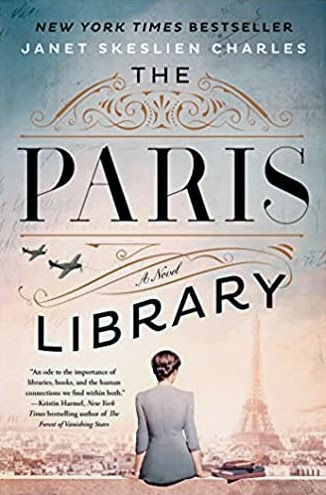
I'm reviewing The Paris Library...

... a novel by Janet Skeslien Charles...

This is a dual time-line story set in Paris during the occupation and the US of the 1980s.  It is also based around the largest English-language library on the European mainland and that library is the American Library in Paris.  With a current address of rue Général Camou in the 7th arrondissement, the library is within a 5 to 10 minute walk of the Tour Eiffel. 
But the library has an interesting story all of its own to tell.  It was established originally, in embyo form, in 1917 as part of the Library War Lending Service in order to supply books to American soldiers who were fighting in Europe during the 1914/18 war.  Once the war was over, the library was firmly established at its first address on rue d'Elysée in the 8th in 1920.  The original stock of books being the core of the wartime lending collection.  It also took the motto 'atrum post bellum, ex libris lux'.  Very fitting when you consider this translates as after the darkness of war, the light of books.
Like a lot of other institutions, The American Library hosts and runs various events across the year - including interviews with authors.  One of those authors was Janet Skelsien Charles and I was lucky enough to get a ticket.  Obviously, I had to join the event virtually.
It was fascinating to discover how the author had researched the history of the American Library in Paris.  The detail she had discovered about the running and management of the place during the occupation and, the interesting snippets of information she had ferreted out about the actual personnel who lived through those very troubled years in the 1940s.
The result of that research was a novel based on the findings from all of that work - information picked up from actual archive documents, interviews with people who had survived the war or their relatives, insights demonstrating how a city coped with being occupied for almost 5 years.  The book was The Paris Library and I found it to be a fascinating tale.
The parallels demonstrated between the central characters in Paris and their later counterparts in the US were interesting and thought-provoking.  I thought that the two timelines were very cleverly woven together and I loved the attention to historic detail.  The day-to-day working of the library became a comforting distraction from the taught and constantly shifting tension created throughout because of the occupation and the ever increasing menace of Nazism.
I thought the charactrers were all very well drawn, although I did not warm to all of them.  It was also interesting to be able to understand how, over time, the central characters when older would make different choices or even condemn or reaffirm previous actions.  I welcomed the opportunity to consider those characters in both a modern and previous light.
A great book and I will be reading more of this author's work.