Tuesday, 22 February 2022

I'm reviewing Snow Country...

...by Sebastian Faulks today.  And what a read it is...

Snow country is one of the most moving books I've read in a long time.  As I read the foreword I realised that it was part of trilogy - the first instalment of which I read when it was first published in 2005.  Faulks, being the incredible writer he is, I'm sure there are details in that first book that will link with and which are pertinent to the story in Snow Country.  But as there is a 16 year gap between the two books, I'm going to have go back and read the first one again to see what I might have missed.

Snow country is essentially a love story, but the agonies and ecstasies of the two central protagonists are so beautifully played.  The missed opportunities, the misguided decisions and actions and the miscommunication - so reminiscent of the Henry James novels that I read as a teenager through to my twenties - are exquisitely examined.  There is such a depth of emotion in this story.  Add in the fabulous landscape of Austria, the looming first war and the march towards a second and the activism prevalent across Europe in the interwar years and you have an ever-present sense of gathering danger through out.

I found the narrative flowed exceptionally well.  I found the characters absorbing, each in their own way, and the plot was well paced and provided interesting turns of fate.  But there is pathos and sadness there too.  This is a two-hanky book.  The first for when you are reading it.  You'll need the second for the days and weeks after you've finished reading it when you discover that Anton and Lena won't leave your thoughts, or for those times when someone makes a comment or asks a question and suddenly you're back with Rudolf, or one of the other characters and yet another deeper level of realisation pops into your conscious mind.  A wonderful read and this book is a keeper, I know I will return to it.

You can also find this review on Amazon, Goodreads and Bookbub and you can find other reviews on this blog Here  Here and Here

Tuesday, 15 February 2022

Please welcome, friend and author Pierre C Arseneault...

...to the blog this week.  Hi Pierre, thanks very much for making time in your busy schedule to be here today.  So, Pierre, just how much do you think you should have plotted out to start writing?

PCA  The answer to this question will be different for everyone as it’s the same as asking if you’re a plotter or a pantser.  Although there is also the lesser known term plantser, which is a blend of the two, which I feel that I am for the most part. There have been times when I’ve started short stories knowing the beginning and the ending but I didn’t have a plan on how to write the middle.  This is why I often state that the middle is the most difficult part for me, although in short stories, you can just write until you feel satisfied.  It’s different when trying this with a novel as there is a word count to also worry about, making the middle an even bigger challenge in an effort to have a novel when finished.  This usually has me mildly obsessing over word count.  A short story called 'Filjan, Filjan' comes to mind.  I know the title is odd and you’ll just have to get a copy of Sleepless Nights and read it to know what it means.  But with that said, when I wrote this story, I had the beginning and the ending firmly in mind, but didn’t have any of the middle. None.  Not even the why it would end the way it did and why Andrew was the way he was.  I just started writing.
Another example is my novel Poplar Falls: the death of Charlie Baker.
I’m sitting at my computer and the urge to write is huge but I’ve no idea what to write.  The blank page to me, represents endless possibilities as it could be anything.  I just knew I wanted to write a novel and it wouldn’t be horror this time. Dark, sure but nothing horrific or scary.  On my bookshelf, facing me was a book which I had recently finished reading called 'Gerald’s Game' by Stephen King.  The image on the cover sparked an idea and I began writing.  I started with nothing but an opening combined with an urge to write and made it to about 15 thousand words before hitting a wall.  I was stuck.  I had no idea how I wanted to continue this story I had gotten so invested in.  I set it aside for a bit and when I came back to it, I made some changes and started over.  Again, I made it about 15 thousand words in and blocked again.
Frustrated, I whipped out a pack of post-its and notepads and started planning what should happen to each character and their storylines.
  I compiled these notes, figured out what order they should be in and began writing again.  So now I had a book that I started pantsing and then plotted out the rest making this a plantser novel.  And after over 20 short stories and five novels (3 published so far), I can tell you that I’m still trying to figure out what works best for me.  I think the story idea will play a really big role in this for me.  My next horror novel called Maple Springs, which is set to come out in October 2022 was completely pantsed.  I tried to plot when I hit walls and wasn’t able to.  Instead I kept working on it and ended up pantsing it entirely.
As for my short story, The Path to Redemption in the Autumn Paths anthology, it started with the seed of a character with a secret path to school to avoid bullies and it evolved from there.

You can follow Pierre on his Website  Facebook  and on Twitter   

You can get his books on Amazon  and a copy of Autumn Paths Here

You can read  more about the anthology Here Here and Here  and on March, 15th another author with a story in the Autumn Paths anthology will be visiting the blog.  Come and join us then...

Tuesday, 8 February 2022

I'm very pleased to announce...

...that the anthology, Autumn Paths, is going on  a blog tour...
 

Beginning Wednesday, February 9th, our anthology will be visiting numerous blogs each day for the next week.  You will be able to read reviews of the whole book and, in some instances, you will see short excerpts from a selection of the stories.  One blogger has also asked us a series of questions - so you can get to know some of us a little better. 


Of course, some of you may want to read the anthology and make up your own mind.  Then please do so and to help you decide here's the blurb :

Nine writers - Seasonal Collective - from both sides of the Atlantic, including best-selling and award-winning authors, have created this miscellany of stories.

These tales of family, mystery, intrigue, adventure, and suspense will take you across continents, through time and space in this world and others.  With a linking theme of autumn, discover new landscapes, encounter new and intriguing characters, uncover secrets and lies, and witness the resolution of old enmities.

Take the first step on this roller-coaster of an emotional journey, and you won't be disappointed.

Here's what others are saying about the book :

⭐⭐⭐⭐⭐ Not a single story here disappointed and I can recommend this book as a great read.  A reader in the UK

⭐⭐⭐⭐ A mix of subjects and authors makes for an absorbing and varied read.  A reader in the UK

⭐⭐⭐⭐⭐ The short stories in this collection are a mix of genres, including mystery, romance, historical, sci-fi and adventure... These snappy, well-written tales are sure to delight no matter the season.   American author, MJ Lebeff

Original, entertaining and a darned good read.  A great collection of stories well told by nine very memorable authors.  Eden Monroe, author of Dare to Inherit, Almost Broken and more

You can get the book on Amazon

You can read more about the anthology Here and you can find out about the story behind my story Here
Fellow writer, Allan Hudson, also visited the blog a while ago and you can read the story behind his tale Here

Look out for visits to the blog from other Autumn Paths authors, Pierre C Arseneault on February 15th, and S. C. Eston on March 15th

Tuesday, 1 February 2022

Off my Beaten Track…

… I'm in Brampton, today.  I've been going through my journals, and I came across my notes from last September when I was unable to travel to France and took myself north to Reiver country instead…


Wednesday, 8th


I'm camped at Clarks Hill Farm.  It's an open field with plenty of space, beautifully kept grass and sheep for neighbours.  There may not be the vast mountainous views that I'm used to when I'm in the Cévennes, but there are stunning sunsets.
Into Brampton today in the sunshine - unusual for the sun to be so relentless here in England!  So unusual that if I closed my eyes, I could believe I was in France.
Brampton is a fabulous little market town.  It sits about 15K's from the city of Carlisle in Cumbria and is about 4K's from Hadrian's wall.  We've got some serious history here, which I can't wait to explore.
The earliest settlement is thought to date from around the 7th century.  In the settlement rolls - an opportunity to raise taxes - of 1252, the town is listed as Braunton and Brampton in a later document from 1291.  The place was granted its Market Charter by Henry 3, and it has continued to trade as a market town ever since.
The octagonal Moot Hall sits at one end of the market square and was built by the Earl of Carlisle in 1817.  It now houses the Tourist Information Office.  It replaced an earlier building from 1648 that Oliver Cromwell used to house prisoners.  The town is also noted for its role in the Jacobite uprising and, if you look carefully as you wander the streets, you'll see the Blue Plaque that tells you that Bonnie Prince Charlie (Charles Edward Stuart) once stayed here.  One other thing to note as you stroll around the market square are the old stocks, used to mete out punishments in earlier times.  I can't help but wonder what stories those stocks might tell if they could talk!
It's almost time for lunch, and I need to find some food to eat on the hoof.  Luckily, at one side of the square is an amazing place called Cranstons.  It's the kind of shop that makes [insert name of the posh supermarket you never use] look cheap.  Nevertheless, the produce is sumptuous, and I purchase a slice of smoked bacon and Emmental cheese quiche for lunch and a slice of Ullswater pie for later.
Leaving the heart of the town behind, I head towards the church dedicated to Saint Martin. The church was designed by Philip Speakman Webb (1831 - 1915).  After qualifying and obtaining a post as an assistant architect to George Edmund Street, Webb became acquainted with William Morris.  Webb and Morris continued their friendship, became associates and central to the Arts and Crafts movement and founded the Society for the Protection of Ancient Buildings in 1877.
Inside, the church is cool and a stunning example of the clean lines and arches of the Arts and Crafts era.  The stained glass windows were designed by Edward Burne-Jones (1833 - 1898), another leading light of the A&C movement and one of the Pre-Raphaelite Brotherhood.  I linger longer than intended as the cool air, and the coloured light from the windows are too great a draw for me to leave them just yet.
Eventually, I wander outside and around the exterior of the church.  I step into Church Lane to find a tiny, sunny square edged with old properties.  As I walk back to the main road, I notice a name plaque - Knuckleskuds.  Now that's a name to conjure with…

If you enjoyed this little jaunt, you might also like other #OffMyBeatenTrack posts.
You can find me in Sicily  and  Verona    

I will be #OffMyBeatenTrack in Reiver country again in April - check out my post Here

Tuesday, 25 January 2022

I'm celebrating the work of A. A. Milne…

… this week. And no, I'm not going to be talking about that teddy bear.   Read on…

Alan Alexander Milne was born on January 18th in 1882 in Kilburn, London.  His father was a teacher who ran a small, independent school.  Milne attended Westminster school and subsequently, Trinity College, Oxford where he obtained his MA.  He grew up in the company of such fabulous writers as H. G. Wells who also worked as a teacher, and played cricket with novelist & playwright J. M. Barrie, Sir Arthur Conan-Doyle and P. G. Wodehouse.  It is perhaps not so surprising to learn that Milne was a playwright before he became known for anything else.
After graduating, Milne wrote witty poems and essays for the magazine Punch, eventually being taken on as a permanent member of staff in 1906 as an assistant editor.  He went on to write a total of 38 plays, published 7 novels - one of which was The Red House Mystery - along with non-fiction, poetry and his collection of works for children.
During the twenties and thirties his plays were regularly staged in the west end of London, and mostly received excellent reviews.  At that time, he was one of our greatest living playwrights.  He wrote his last play, Before the Flood, in 1951 and during his lifetime he also adapted some of his stage plays for screen, working with highly acclaimed actors at a the time such as Leslie Howard and C. Aubrey Smith.
I was first introduced to Milne through his poetry, which I had to learn and recite for poetry-speaking exams and competitions.  Some of those stanzas have remained etched into my brain.  As a seventeen-year-old, I came across the playwright Milne and found myself playing roles and learning speeches for yet more exams, competitions and local productions.  I loved his dialogue, which scintillated on the pages of those scripts, not to mention the opportunity to dress up in fabulous period costumes.
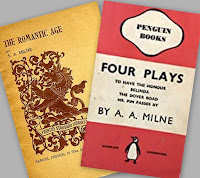
But, the connection with the Milne of my childhood completely eluded me until I was working in London and had a book collecting habit that was in its infancy.  About a twenty minute walk from my office was a dark and dingy second-hand bookshop.  Whilst rummaging through a box of heavily foxed paperbacks I came across a 1938 Penguin edition of Milne's locked room mystery story.  It was in a bit of a state, the cover was detached and some of the pages were in danger of being lost forever.  But I bought it for a few pence.  It was only when I read it a few months later that I realised that the man of the plays, the wit and the cracking dialogue was the same man who created the poetry.
Unfortunately, I no longer have that paperback.  I'm not sure what happened to it, but the book has been replaced by a hardback in much better condition.  It's not a first edition - I'd need to own a bank to get one of those - but it is on my shelves with my childhood copies of his poetry and some of his scripts.
Examples of Milne's Playscripts
Milne's writing life is only part of the story.  He served during both wars, taking a commission with the Royal Warwickshire's in 1915 and then serving with the Signals.  He was injured at the Battle of the Somme, and once recovered, he remained in the UK and served with Military Intelligence.  During the 1939/45 conflict he served as a Captain in the British Home Guard. He continued writing right up until 1952 when he suffered a stroke and underwent brain surgery, which left him an invalid.  He died on the last day of January in 1956.
I find it quite sad that Milne's extensive body of work is now completely overshadowed by a teddy bear that you can find in just about every toyshop.  And yes, I do have to admit that even I've got one.  But he is a very small version and he sits in the door pocket of my car. However, when anyone ever mentions A. A. Milne to me, my thoughts always stray to the stage, his dialogue, his novels and his poetry.

I'm celebrating the life and work of other authors in earlier posts, which you might find interesting.  You can also read about Willa Cather  William Golding 

Tuesday, 18 January 2022

Please welcome, friend and author Marilyn Pemberton...

...to my blog this week.  Hello Marilyn and thanks for making time to be here today.  Your journey to being a writer has been quite different from mine, so tell me all about it...

I started writing late in life.  Having taken a BA, MA and PhD as a very mature student, I managed to get a biography of Mary De Morgan, Out of the Shadows: the life and works of Mary De Morgan, published in 2012, when I was in my late fifties.  I then wrote a fictional account of De Morgan’s life, The Jewel Garden, and after almost a year’s worth of rejections it was published by a small, independent publisher in 2018.  Unfortunately, he stopped taking submissions a few months later.
Whilst I was trying to get The Jewel Garden published, I heard a programme on the radio about how in eighteenth-century Italy boys were bought from poor families, castrated and taught to sing; the seeds of my next novel were sown. Within a year I was ready to send Song of the Nightingale: a tale of two castrati out to a long list of literary agents and publishers.
After months of depressing rejections.....I had a call in August 2019 from a publisher, who said he absolutely loved my book - music to an author’s ears. There followed, however, days of indecision, sleepless nights, numerous calls with the publisher, e-mails to other writer friends,  much trawling through the internet and speaking with a couple of the authors on the publisher's list.
The reason why the decision was so hard?  Because he wanted me to pay £755 up front for the administration and the design of the cover.  Oh, and another five hundred or so for 300 copies to be printed (200 of which would be delivered to my door for me to sell).
I could hear the screams of "Nooooooooooooooooooo!" and the mantra "Authors should never, ever pay a publisher" resounding around the country.
The publisher assured me that they are not a vanity publisher; they are a hybrid-publisher – this being somewhere between a traditional publisher and self-publishing, a route I wasn’t yet willing to go down.
Having convinced myself it wasn’t a vanity publisher, I eventually decided to go with them.  After all, I was merely paying for a service: a professionally designed cover; a book ready for publication and on the world-wide e-book sales sites; print copies available and all the things a traditional publisher does.  If I had self-published I would have had to do all these things myself.  I was lucky enough to have the money and I was thrilled that someone else loved my book and really, all I wanted was to get it out there so that people could enjoy it.  Was that too much to ask?  Am I the devil’s spawn for being willing to put some money where my mouth is?
I think not, but will I use the publisher again for my new books?  No, for the following reasons:
I can no longer afford it. Song of the Nightingale has not earned anything like enough to cover the costs.
I still have about 150 books in a cupboard; there is no room for more.
I was lucky enough to find a literary agent eighteen months ago and am hoping she will find me a publisher.
If she doesn’t and I have to go down the self-publishing route, then I think I can achieve what the publisher did for far less and I would keep all the profit.
However my next books are published I will still need to market and promote myself.
Do I regret paying to get Song of the Nightingale published?  Absolutely not!
There are lots of horror stories of authors being suckered in, sending their money and never seeing a printed page, but I now have a beautiful book that I am immensely proud of and that is available for readers to enjoy.
 
about the book… Philippe, the narrator of this tale, is secretary to Count De Lorenzo, and lover to the Count’s young wife. He is tasked with buying young boys from poor villagers, having them castrated and taking them to Florence to be taught to sing as castrati. The parents are told that their sons are especially blessed with their wonderful voices and they do not object to the boys making a physical sacrifice in order to thank and praise the Lord; nor to the bag of gold they are given in exchange.
The boys are innocents, victims of circumstances beyond their control. Surely they can have nothing to do with a barber’s mysterious death, or the suicide of an abusive Jesuit priest?
This is a tale of passion, revenge, guilt, regret, loss and redemption.
Would you sell your son so he can forever sing God’s praises? If it means he will lead a better life than you can offer him? If it means a bag of gold for you? If it means the boy is castrated and will never lead a 'normal’ life?
Winner of the 2020  International Rubery Book Award Fiction Category.

You can get the book and follow Marilyn on Amazon.com

You can follow Marilyn on her Website Blog Facebook  and on Twitter

Tuesday, 11 January 2022

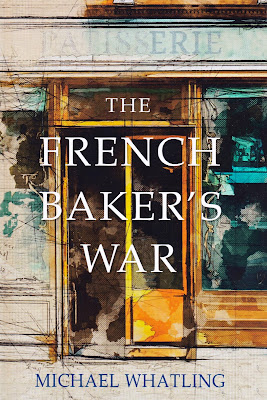
I'm reviewing The French Baker's War…

… by Michael Whatling.

When I pick up a book that is set in France I can't stop myself from also picking up my map.  It's a bad habit, I know, but I just have to be able to see where the characters are at all times.  And you never know, I might come across a place that I decide to visit for myself when I'm next able to travel.  The other wonderful thing about books set in France is that I can live vicariously through the characters and thereby stave off my disappointment about not being able to be in France myself because of the current restrictions.  But it's a new year and, fingers crossed, I will be traversing the Channel in the not too distant future.
As for the book, it's set during the occupation and focuses on a few months during 1943.  Mireille and André are the married couple that own the local pâtisserie in the village of St-Léry d'Espoir in Bretagne.  But it's October and the weather is getting colder.  The hardships of the occupation are getting more stringent and there's an ingrained fear that permeates the village which comes with being constantly watched, being unable to be sure who can be trusted.  That pervading and ever growing sense of fear is in the words and actions of all the characters throughout the whole of the story.
In many ways this is a dark tale set during France's années noires and yet the over-riding theme is love.  When Mireille suddenly and without explanation disappears, André is completely lost.  Add into the mix the arrival - unannounced and unexpected - of a woman who has clearly been held prisoner and has escaped and you have a scenario that is dangerous for the whole village, not just the pâtissier and his small son.
The story is told - in beautiful prose - from various points of view and mostly in the present tense, which puts the reader right at the heart of the action.  The reader has the opportunity to feel what André feels, to instantly understand his anguish at his wife's disappearance and his frustration with the new situation in which he finds himself.  As the story unfolds and the motivations of the various characters are revealed, it becomes clear that not everyone has acted for the best of reasons.  In that respect, this story reads a little like a mystery as it moves to a surprising conclusion.
As for St-Léry the village, there really is one in the département of Morbihan (56).  It is a small place of less than 200 people.  Does it have a pâtisserie?  No, but it does have a road called rue de la Boulangerie where there might once have been such an establishment.  Is this the real village of the story?  I don't know, but the author does say at the outset that his novel is 'Inspired by a true story.'  Another little thing about this village is that there is a war memorial that stands across the road from the Mairie and, try as I might I'm not able to read the details on Google Earth.
Lastly, the history of the village is interesting.  The land upon which the village stands was given to Saint Léry (to whom the church is dedicated) by Judicaël, a King of Bretagne, around 632, with the intention that a monastery be established.  That is the earliest record of the village and it became a formal municipality after the revolution.
Of course, all of that history means that I will have to go there if only to visit the 16th century church and the memorial for myself.  Naturally, I will also have to sniff out the real story behind the book!

You can read a shortened version of this review on Amazon, Goodreads and Bookbub.  There will be more book reviews in the coming weeks and months...