Tuesday, 28 June 2016

An interview with...

...fellow Crooked Cat author, Tim Taylor.  Morning Tim

TT  Hello Angela, many thanks for inviting me along today.
AW  You're very welcome Tim and I know your time is precious,so tell me, what is your current release?
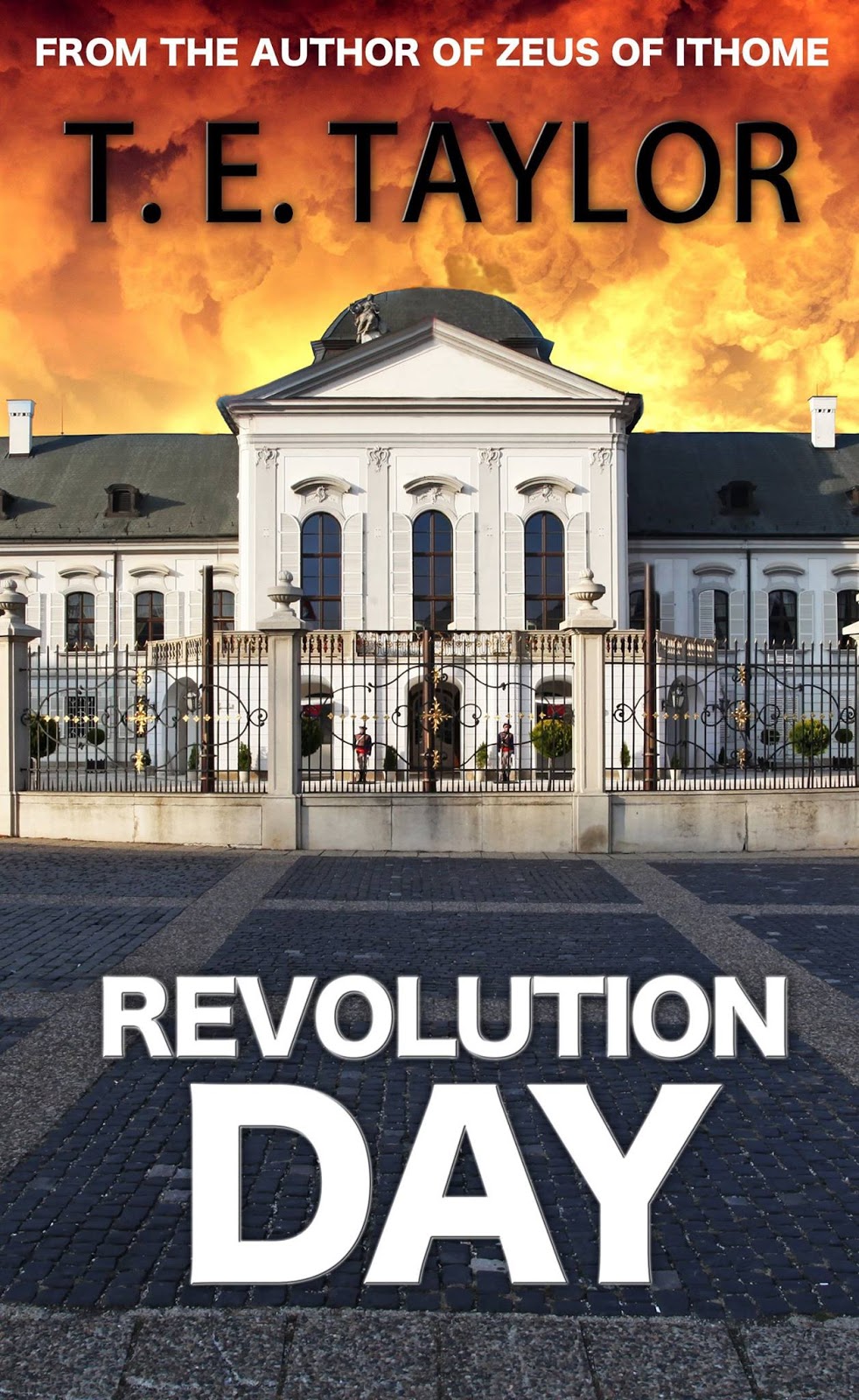
TT  My most recent novel, Revolution Day, follows a year in the life of ageing Latin American dictator, Carlos Almanzor, who is feeling increasingly insecure and paranoid as he clings on to power.  His estranged and imprisoned wife, Juanita, is writing a memoir in which she recalls the history of their marriage and Carlos’s regime, charting its long descent from idealism into repression. 
Meanwhile, the vice-President, Manuel, is burning with frustration at his subordinate role.  When his attempts to increase his profile are met with humiliating rejection, he resolves to take action.  But lacking a military power base, he must pursue power not by force but through intrigue, exploiting his role as Minister of Information to manipulate the perceptions of Carlos and those around him and drive a wedge between the President and the Army.  As Manuel makes his move, Juanita and others close to Carlos find themselves unwittingly drawn into his plans.
For the last week in June and the first two weeks in July (only), Revolution Day is on special offer at 99p/99c.  Further information on the novel, including excerpts and reviews, is available on its page on my website.

AW   What first got you into writing and why?
TT  I’ve always had a creative urge, and I’ve enjoyed writing ever since I was at primary school.  It’s always been a part of my life at some level.  That said, there have been periods when I have found it difficult to make time to do much serious writing, and others when that creative urge found different outlets.  But in the last few years I’ve been able to give much more time to writing, and I’m very happy about that.

AW  You write historical and contemporary novels.  Is it all imagination or do you also undertake research?
TT  It depends.  My first novel, Zeus of Ithome, was set in ancient Greece and followed real historical events – the struggle of the Messenian people to free themselves from centuries of slavery under their Spartan neighbours, and the wider political and military wrangling between rival Greek states.  I already had a good background knowledge of the Greek world, having studied it at university, but I had to do quite a bit of research into the events I was writing about and certain historical characters who appear in the novel, as well as into the way people lived, dressed, ate and fought.  I read the ancient sources and some modern history books, and made heavy use of Wikipedia and Google Earth (for places and landscape).
Revolution Day, on the other hand, was about fictional events set in a fictional country, so it required a lot less research.  I still did some, though – e.g. into hispanic names.  I also looked at a number of historical dictators, though my character, Carlos, is not based upon anyone in particular. 
The novel I am currently writing falls somewhere between the two. It is about a woman’s relationship with her father, as he starts to lose his memory and live increasingly in the past.  I’ve done a fair bit of reading on dementia, and may need to do some historical research about the Second World War period. 

AW  And what about other types of writing?  Have you ever dabbled with short stories, for instance, or other genres?
TT  I write poetry and the occasional short story.  I’ve recently been experimenting with spoken word accompanied by music (at open mic events and the like).  I also write academic non-fiction – my background is in philosophy.  Most of my recent research has been on well-being: what it is, how to measure it and its role in public policy.   

AW  Famous authors, such as Roald Dahl and Dylan Thomas, had a special space for writing. Do you have a writing ‘shed’ of your own?
TT  Not really. I used to do all my writing in a small room we call ‘the office’, which houses a PC, bookshelves, filing cabinets and the like.  I do still work there (I’m in the office right now), but the trouble is that the PC is such a source of distractions, mostly from the internet, that I don’t work very efficiently on it.  For my current work in progress I’ve taken the decision to write downstairs in the living room.  I do have a music room (another interest of mine), and ultimately I’d like it to become the writing room as well, but at the moment it’s too cluttered up with guitars and other musical paraphernalia. 

AW  Finally, if you had a whole afternoon to yourself and could choose to spend it with anyone, living or dead or a character from a book.  Who would it be, and what would you want to discuss?
TT  I’d like to take a person from ancient Greece or Rome, possibly someone like Aristotle or Cicero, and show them as much as possible of the modern world, just to see what they thought of it.

AW  What an interesting idea Tim.  But I’m afraid there’s no room for either or, I’m going to have to press you – Aristotle or Cicero?
TT  It would be great to have them both as it would be interesting to see what they had to say to each other.  But if I'm restricted to just one, as a philosopher, I have to choose Aristotle.  Thanks again for your hospitality, Angela!
AW  You're welcome!

About the author Tim was born in 1960 in Stoke-on-Trent.  He studied Classics at Pembroke College, Oxford (and later Philosophy at Birkbeck, University of London).  After a couple of years playing in a rock band, he joined the Civil Service, eventually leaving in 2011 to spend more time writing.
Tim now lives in Yorkshire with his wife, Rosa, and divides his time between creative writing, academic research and part-time teaching and other work for Leeds and Huddersfield Universities.
Tim’s first novel, Zeus of Ithome, a historical novel about the struggle of the ancient Messenians to free themselves from Sparta, was published by Crooked Cat in November 2013; his second, Revolution Day in June 2015. Tim also writes poetry and the occasional short story, plays guitar, and likes to walk up hills.
Revolution Day on Amazon UK, Amazon US

Tuesday, 21 June 2016

Following Stevenson through the Cévennes

A mountain village
In 1878, when Robert Louis Stevenson decided he would travel through the Cévennes, I'm not absolutely sure that he had considered the seasons, the weather or the look of the countryside.  In his book 'Travels with a Donkey' he mentions to his friend, Sir Sidney Colvin (1845-1927), curator, literary and art critic, that 'we are all travellers' through the 'wilderness of this world'.  Later, in writing about his visit to Luc and Cheylard he says that he travels 'not to go anywhere, but to go.'  He admits he 'travels for travel's sake' and to 'feel the needs and hitches of our life more nearly.'  So I am left wondering, as I have on every other occasion when I've read his book, why he chose to visit this part of France in September and October, as June, in my view, is one of the best times to be here.

As I cross the Col de la Pierre Plantée I marvel at the myriad shades of green around me.  From the pale green of the grass to the dense, inky, champagne-bottle green of the pines.  And in amongst this verdancy are the sunshine yellow clumps of the mimosa that jewel the landscape along with the grey of the vast boulders that seem to be growing out of the ground.  I'm reliably informed that these vast boulders have a specific name - glacial erratics.  Apparently, millions of years ago when this vast untamed area was being formed, the shifting ice sheets brought with them enormous lumps of rock and, as the ice melted and receded, the rocks remained.  I glance at the map and think, technical name or not, I'm with the French on this one.  If they can have a col named after planted rocks, then so can I!

The colours of the Cévennes

Stevenson was not very complimentary about the tiny village of Luc - my destination for today's blog and I have to disagree with him.  The village sits in the valley of the Allier with an old chateau above on the strategic high point.  The path to reach the ruins is rough and begins at the top of the village.  As I am about to begin the climb I meet a modern 'Stevenson' coming down.  I ask him if his donkey is called 'Modestine'.  He hesitates for a moment, then shakes his head and says 'Mouka'.  And then he is gone.  I would have liked the opportunity to talk further, but it is clear he is a man on a mission and I gain the impression that French is perhaps not his first language.

From the chateau ruins it is possible to begin to understand the wildness of this place and how solitary any existence here is.  I can hear cowbells in the distance as the Aubracs sit in the sunshine, graze and then sit again.  Madame at my campsite told me the other day that the last snowfall this year was on May 1st.  Autumn is cold and often brings the icy winds that herald snow and when the snow arrives so do the cross-country skiers.  And just to give some perspective, the chateau at Luc is about 1000m above sea level.  The Col de la Pierre Plantée is 1263m above sea level and my campsite is more or less the same.  Ben Nevis is just over 1300m in height.  So, Stevenson and me are effectively travelling the highest mountain in Britain.  At this height, the population is sparse, the villages small and the air is clean and sharp.
The Valley of the Allier from the chateau at Luc

At 'aperitif-o'clock', in the quiet of the early evening sunshine, I raise my glass to my book and say, 'Robbie, as old and as trusted a friend you are, you picked the wrong time of year to be here.'  As the breeze dies, the pollen from the trees settles and the scent of the air is heavy with pine and chestnut and wood sap.  'Robbie, you missed the taste and the colour of the Cévennes'.

There's more from RLS and me here

Tuesday, 14 June 2016

Chagrin, Ohio, the Appalachians, & Me

Please welcome Sheila North, radio presenter, author and American living in the UK, to my blog this week.  Continuing the theme of travel and life abroad Sheila gives away a few secrets about her life before Yorkshire!

Hound of the Basingstokes
Illustration byTom Brown 
The state of Ohio (OH) is the birthplace of my favourite American humorist, the late James Thurber.  I'd love to be the visiting writer at ‘The Thurber House’, in Columbus, OH.
Another Ohio treat is the charming small town (population 4,113) of Chagrin Falls, which I visited in the early 1980s.
What's not to like about Chagrin Falls?  For starters, there's that name.  It conjures up images of early 19th century American pioneers, bravely going where no pioneer has gone before.  Unfortunately, instead of the Pacific Ocean, they found a river, and a waterfall.
They were chagrined.
I enjoy writing about real places, which is why most of the short stories in my collection Koi Carpe Diem are based in my home town of Doncaster, South Yorkshire.  One exception is The Hound of the Basingstokes, which is set in a flat in Baker Street, London.  Bunty Jennings: Tree Whisperer takes place in a fictionalised version of Doncaster called Danefield.
Bunty Jennings : Tree Whisperer
Illustration by Tom Brown
Basing fictional places on real ones is great fun, and is what I'm doing with the title story of my upcoming collection, A Yorkshireman in Ohio.  The Yorkshireman is Inspector P. Thwaite, who arrives in Sweetheart Springs, Ohio, with his sidekick, Sergeangt Jake Cat.  Who is a cat, and well pleased to find that Sweetheart Springs is much warmer than Doncaster.  The picture book town of Sweetheart Springs owes a lot to fond memories of Chagrin Falls, although I doubt the latter has ever been the setting for death by tentacle.
I haven't yet placed a story in or around Appalachia.  I suspect it's just a matter of time.  When I was a child, we used to go on vacation every summer.  Mom and Dad would pack the light blue Ford Mercury with kids, colouring books, and suitcases, then drive around visiting other states.  In the morning, Dad would ‘fill 'er up!’ at a gas station.  Come lunchtime, the family stopped for sandwiches, or burgers, followed by ice cream sundaes, chocolate malteds, or a ‘Brown Cow’ - that's a root beer float - at Big Boy's, or Howard Johnsons, or perhaps just a snack and a shop at Stuckeys. Much of my plastic horse collection came from Stuckeys.  Their peanut brittle was pretty good, too.
My favourite vacations were in the Blue Ridge Mountains, where we visited Berea, Kentucky, and bought a copy of a folk songbook called ‘Sweet Rivers of Song’ which I still treasure.  Memories of Virginia, West Virginia, and Kentucky call to me, even as I write these words.  Someday, I'll feel that cold, early morning mountain air; smell the pines, and look down at the little lights in those big valleys.  And, of course, feast on genuine Southern cooking.  It's rather like Scottish: if it's edible, fry it.
John Denver was right.  It really is almost heaven.

Sheila North
Photograph by Keith Hartley
About the author  I was born in Detroit, Michigan.  This is not necessarily my fault.  I have been a stringer, newspaper editor, tollbooth attendant, comms assistant, journalism student, writers’ group leader and mental health worker.  I also bake the best brownies in South Yorkshire.  My interests include volunteering with a local radio station, singing angst-ridden folk songs, falling asleep in front of the telly and mangling the English language with my Mid-Western-Yorkshire accent.  I live in Doncaster with my husband David, a rat named Charles and a Dalek called Gerald.

About her work  To read more of my writing, visit my blog sheilanorth.wordpress.com, or look on Amazon for my dark fantasy The Woodcutter’s Son; my short story collections, What No Pudding? and Koi Carpe Diem (print copies available from Lulu) the short story collection that precedes A Yorkshireman in Ohio.  The latter is due for publication this month.  You can also hear me on Bookit!, my radio programme about books and writing at sinefm.com

Tuesday, 7 June 2016

Following Stevenson through the Cévennes

Florac, a gathering of motorbikes
I’m travelling the Corniche des Cévennes for this post.  And yes, I do know that wasn’t Stevenson’s route from Florac to St-Jean-du-Gard.  But there’s a very specific reason for this, so read on…
A few centuries ago Florac - around 2000 inhabitants now, so small by our standards - was the capital of the one of the eight baronnies of the Gévaudan and therefore under direct control of the Bishop of Mende.  The area of the Gévaudan was known for the harshness of its landscape and the cruelty of its fuedal rule, giving rise to the proverb ‘pays de Gévaudan, pays de tyrans’.  The countryside of Gévaudan is the countryside of tyrants!  
But let's put the history aside for a moment and consider the geography.  Flanked by the Causses Méjean on the west and the Cévennes and Mont Lozère to the north, east and south.  Florac sits at around 550m above sea level.  Yet another charming little place, worth a languid visit, for the park that flanks the chateau alone, before setting out along the D907 and then the D9 to drive along the roof of the world!
I was last here one Sunday morning in September a few years ago and, on the outskirts of town I happened upon ‘Le Tour de France’ for old motorbikes.  I had to stop and stroll around these beautiful machines.  There were BSA’s BMW’s, Mobecane, Motoguzzi and a particularly nice BSA Bantam, I think.  All in stunning condition.  I watched as they started to leave in a steady, timed stream of thrumming engines and exhaust fumes.  RLS missed that, I thought!
Stevenson headed east to Cassagnas using drover’s tracks signposted by stones.  I cut south along the Corniche (D9) and towards St-Jean-du-Gard.  The road runs between two river valleys – Les Gardons Ste Croix and St Jean - and rises to around 1000m.  The highest point was for lunch, to enjoy the view, watch a very large bird of prey slipping from thermal to thermal above and to wonder about the Dutchman who had disturbed my solitude on a previous visit.  I recalled that, after noting the plates on the car, he had said he thought the scenery was as beautiful as that in England.  I remember having to disagree.  Then he pulled up a picnic chair and started chatting, eventually telling me about his home in Freisland, the medals he had won in the annual ice skating marathon along the canals and finally, his work for the resistance during the war.  His parting comment being, that of all the medals he owned, he was most proud of those for his skating.  As I ran over the conversation I wondered if his wife had recovered from the illness that had caused her absence, that day, and if both of them were still around, I wished them well.
Bridge and river near Florac
The sun was encouraging new freckles to develop and my skin to complain so I decided to move on.  The road twists and turns through rocky outcrops, parched course grass and sweet chestnut trees growing wherever they can find a foothold.  Seeing a local lady harvesting the chestnuts, I decided to follow suit.  ‘They won’t be quite ready to eat yet,’ she said.  I nodded and thanked her but decided against telling her I’d done this before!  On that previous visit there had been an elderly couple collecting the chestnuts and it was Madame who shared with me her recipe for flan aux marrons.  As a small and grateful tribute to her for introducing me to yet another amazing taste of France I decided to put flan aux marrons on the Sunday lunch menu at the fictional restaurant in my novel, Messandrierre.
Stevenson made it to St-Jean-du-Gard, as did I, but I took the high road and I know what he missed!  

There's more from RLS and me here

Tuesday, 31 May 2016

Another Sneak Preview of...

...Tall Told Tales.  Following on from last months excerpt from my anthology of strange fairy tales, I thought I'd let you see the cover art for the book.  I'm also including an excerpt from the lead story, The Physic Garden, for you to enjoy...

Cover Art by Rosie Jones
Once upon a time, in a place so very far from here, there lived a baker who was lonely.  Although he had a job he loved and owned his own bakery and shop, there’s was no one with whom he could share his life.  And that saddened him.
Looking at himself in the mirror early one morning he decided that he was not so unattractive that he could not find that special someone.  The someone who was meant just for him.  Turning to his right and examining his profile he acknowledged that, perhaps all the cakes had made him a little portly around the waist.  But, he told himself, if he tried hard enough, he could regain his youthful physique.  Well, maybe reduce the roundness of his belly a little, at least.  And, yes, the hair at his temples may be showing the first signs of greyness, but otherwise, he thought he had a lot to offer.  After all, his income from the bakery was very good, despite the hours.
For the next few weeks he scanned the personal columns searching for groups to join and personal adverts from ladies looking for companions or perhaps a little more.
His foray into ballroom dancing was ended before it began.  He had no idea he was supposed to bring a dancing partner with him and was turned away at the door.
A brush with amateur dramatics was equally fruitless, if a little longer lived, as he failed his first audition and had to suffer the ignominy of being told not to give up the day job!
Joining a poker club was too masculine for his requirements and becoming an after-dinner speaker drove him to nervous distraction.  After much thought he decided to take a more modern approach and signed up to a dating dot-com site.
Within no time at all he had found the girl of his dreams, well almost.  Elaine, he had to admit, was not the prettiest woman he had ever seen.  But ‘beggars can’t be choosers’, he told himself.  After all, he thought as he returned to the bakery following their first real date, her hair may be very short, whereas he preferred long, and it may be very black, whereas he prefer blonde, but her large round spectacles did mirror the roundness of her very pale face.   And so Robbie continued to measure her similarities and differences from the real woman of his dreams.
Six months later, as they walked down the aisle together, Robbie thought his new wife was a little portly, like himself and he persuaded himself that this was better than his preference for someone slimmer.  As they stood on the steps of the church posing for photographs, Mr MacDough thought how sweet life would be for him and his new wife at the bakery.  
But the morning after the happy couple returned from honeymoon Robbie realised that his future may not be quite what he was hoping for…

You can find Rosie Jones on Facebook at Rosie Draws Pictures

Tuesday, 24 May 2016

An interview with…

...Jeff Gardiner.  Welcome to the blog, Jeff and thanks for agreeing to be put the microscope!

 AW   What is your current release?
JG  ‘Pica’ is a Young Adult (YA) fantasy about our relationship with the natural world.  The main character discovers some of the ancient secrets and magical powers that have been hidden for thousands of years.  It is the beginning of the ‘Gaia’ trilogy which explores environmental themes.
 AW   What first got you into writing and why?
JG  I’ve always wanted to write – “I write therefore I am”.  My head is full of images, stories and events that I need to express somehow before I lose my mind completely.  As a kid I wrote terrible stories and self-indulgent poetry.  My first real publishing success occurred when an adaptation of my MPhil thesis was published.  This gave me the fillip I needed to write some short stories which found homes in magazines and anthologies in the UK and US.  And I went on from there.  My first novel, ‘Myopia’ was accepted by Crooked Cat, and since then I’ve refused to give up…
AW  You write YA and Contemporary novels.  Is it all imagination or do you also undertake research?
JG  Most of what I write is imagined, but ‘Igboland’ is set in Nigeria – where I was born – and that involved lots of research into Igbo culture and beliefs, as well as the Biafran War, which is the historical context of that novel.  It was a fascinating process and when you immerse yourself deeply into a completely new culture it starts to affect your own perspective on things, and your way of thinking.
AW  And what about other types of writing?  Have you ever dabbled with short stories, for instance, or other genres?
JG  Yes, I have a collection of short stories called ‘A Glimpse of the Numinous’, which contained a range of genres: horror, slipstream, romance, comedy and surrealism.  Not all my novels are YA.  ‘Igboland’ and ‘Treading On Dreams’ include mature themes and episodes.  And I even have an erotic novel out under a pseudonym!
AW  Famous authors, such as Roald Dahl and Dylan Thomas, had a special space for writing.  Do you have a writing ‘shed’ of your own?
JG  I wish.  No, I have a laptop on my dining room table, or sometimes on my lap (weird!).  If I ever become more successful then a writing-shed is something I’ll have built (but the dilemma will be: should I include a TV with Sky Sports or do I want to get some writing done?).
AW  Finally, if you had a whole afternoon to yourself and could choose to spend it with anyone, living or dead or a character from a book.  Who would it be, and what would you want to discuss?
JG  My hero is Gandhi.  We could do with his wisdom and clarity on a number of issues right now.  Whenever I have a discussion with friends about politics I wonder what Gandhi would say.  I’d ask him a million questions and jot down his pearls of wisdom.  I’d also love to chat with Herman Hesse for similar reasons.  The philosophy in his books is inspiring and mesmerizing.  If I could be transported into a book I’d like to visit Mervyn Peake’s Gormenghast and get lost in the endless walls of the castle filled with hilarious and lunatic characters.
AW  I make that three people Jeff!  A tad greedy don’t you think?  So I’m going to have to press you because the idea is to spend the afternoon with one person…
JG  Ghandhi.


Author Bio  Jeff Gardiner is the author of four novels (Pica, Igboland, Myopia and Treading On Dreams), a collection of short stories, and a work of non-fiction. Many of his short stories have appeared in anthologies, magazines and websites.
Pica is the first in the Gaia trilogy – a fantasy of transformation and ancient magic, which Michael Moorcock described as “An engrossing and original story, beautifully told. Wonderful!”
 “Reading is a form of escapism, and in Gardiner’s fiction, we escape to places we’d never imagine journeying to.” (A.J. Kirby, ‘The New Short Review’)
For more information, please see his website at www.jeffgardiner.com and his blog: http://jeffgardiner.wordpress.com/


About the Book  Pica explores a world of ancient magic, when people and nature shared secret powers.
Luke hates nature, preferring the excitement of computer games to dull walks in the countryside, but his view of the world around him drastically begins to change when enigmatic loner, Guy, for whom Luke is reluctantly made to feel responsible, shows him some of the secrets that the very planet itself appears to be hiding from modern society.
Set in a very recognisable world of school and the realities of family-life, Luke tumbles into a fascinating world of magic and fantasy where transformations and shifting identities become an escape from the world. Luke gets caught up in an inescapable path that affects his very existence, as the view of the world around him drastically begins to change.
Accent Press
Amazon Australia

Tuesday, 17 May 2016

Following Stevenson through the Cévennes

The village of Le Pont-de-Montvert
In 1878, Robert Louis Stevenson (1850 - 1894) left Le Monastier-sur-Gazeille for a walking tour of the Cévennes.  And in Place de la Poste in Monastier there is a small marble stone commemorating the fact that Stevenson and his donkey, Modestine, left there on September 22nd.  I have a photo of this modest record of a piece of history somewhere, I think.
I’ve spent many days and weeks in the Cévennes myself, following in RLS’ footsteps.  And with my well-thumbed copy of his book, ‘Travels with a Donkey’, I have covered the same journey on more than one occasion.
But it’s Le Pont-de-Monvert that is of interest.  Stevenson reached here on Saturday, September the 27th.  It’s a charming cévenol village on the south face of Mont Lozère with probably around 250 to 300 inhabitants.  It sits at an altitude of around 800 metres above sea level and that’s just about enough to escape the blistering heat of the plain but still enjoy the southern warmth.  The Tarn – which rises due north of here on the Col de Finiels – is a swift flowing stream in comparison with its wider, more developed self as it slices through the Episcopal town of Albi on its way to the Garonne and finally the sea in the Bay of Biscay.
In Montvert there is the one bridge with a single span to take you across the river.  And this is the same bridge Stevenson crossed and it has been here since the 17th century.  I can’t help but wonder about the owners of the other feet that were here before me.  A troubadour travelling north from Provence, perhaps.  Certainly merchants and drovers and perhaps a knight or two, in shining armour maybe, on white destriers...probably not...but I think it's a nice idea!
Le Pont!
The heart of the village is little changed from when Stevenson saw it and, although the place differed from Monastier and Langogne, he was unable to state in what way but to admit only the ‘difference existed, and spoke eloquently to the eyes.’  For Stevenson it was the town’s role in the battles between the Huguenots and the Camisards that was of most importance.  In his journal he recounts the story of abbé de Chayla and his terrible death in the village on July 24th, 1702.
For me there is an earlier connection.  In 1309, or 1310 depending upon which account you read, Guillaume de Grimoard was born in the chateau de Grizac which sits on the hillside above Montvert commanding the fiefdom.  He became the future pope, Urban V.  In Mende, some fifty kilometres from Montvert, the square in front of the cathedral is dedicated to Urban, now with an added letter 'i' to give, Urbain.  And it is in this square, Place Urbain V, that one of the missing travellers in my book, Messandrierre, is last seen alive.

There's more from RLS and me here